

 English
 Español


Contact us
Need more information about Ruilong solutions? Need to contact Ruilong sales or after sales assistance? Get in touch!

Content
Commercial kitchens rarely destroy a grinder with one dramatic overload. They destroy it with a 550 W unit asked to run four hours a day, six days a week, on frozen product and fibrous root vegetables. The duty pattern, not the peak load stamped on the nameplate, is what separates a genuine heavy duty electric grinder from a countertop mincer with heavy-duty wording on the carton.
This guide works through the decisions that actually change outcomes: how rated power maps to throughput, which stainless grade belongs in the food zone, what a 3000 W motor demands from your electrical installation, and the failure patterns that quietly shorten service life. The reference points come from the commercial grinder line built by Yongkang Ruilong Electric Appliance Co., Ltd. in Yongkang, Zhejiang, and from the electrical and food-safety standards commercial kitchens are inspected against.
A heavy duty electric grinder is a commercial machine rated for continuous or near-continuous duty, typically 750 W and above, with a motor built to run for hours rather than minutes, food-contact parts in 304 stainless steel, and a hardened cutting assembly sized for tonnage rather than occasional batches.
Four checks separate that category from marketing language.
Electrical and sanitation approvals are the second filter. Commercial electric kitchen machines sold into the Chinese market are tested against GB 4706.38-2008, the national adoption of IEC 60335-2-64 covering particular requirements for commercial electric kitchen machines. Equipment bound for North America is normally evaluated to NSF/ANSI 8 for sanitation and to the UL 763 family for electrical safety.
Rated wattage sets the ceiling on throughput, and inside a single vegetable grinding line the spread is wide: capacity climbs from 550 W on the RT220 granular machine to 3000 W on the 450 large granular vegetable mincer, a 5.5-fold difference in motor rating for machines doing the same basic job of reducing vegetables to granules.
The duty cycle behind each figure matters more than the figure itself. A 550 W high-speed unit is specified for granular vegetable work in short, repeated runs. A 3000 W four-blade machine is specified for continuous stuffing production where the cutting chamber never fully empties. Placing the smaller machine on the larger machine's schedule is the most common specification error in commercial kitchens, and it shows up as darkened windings and a motor that smells hot after ninety minutes.
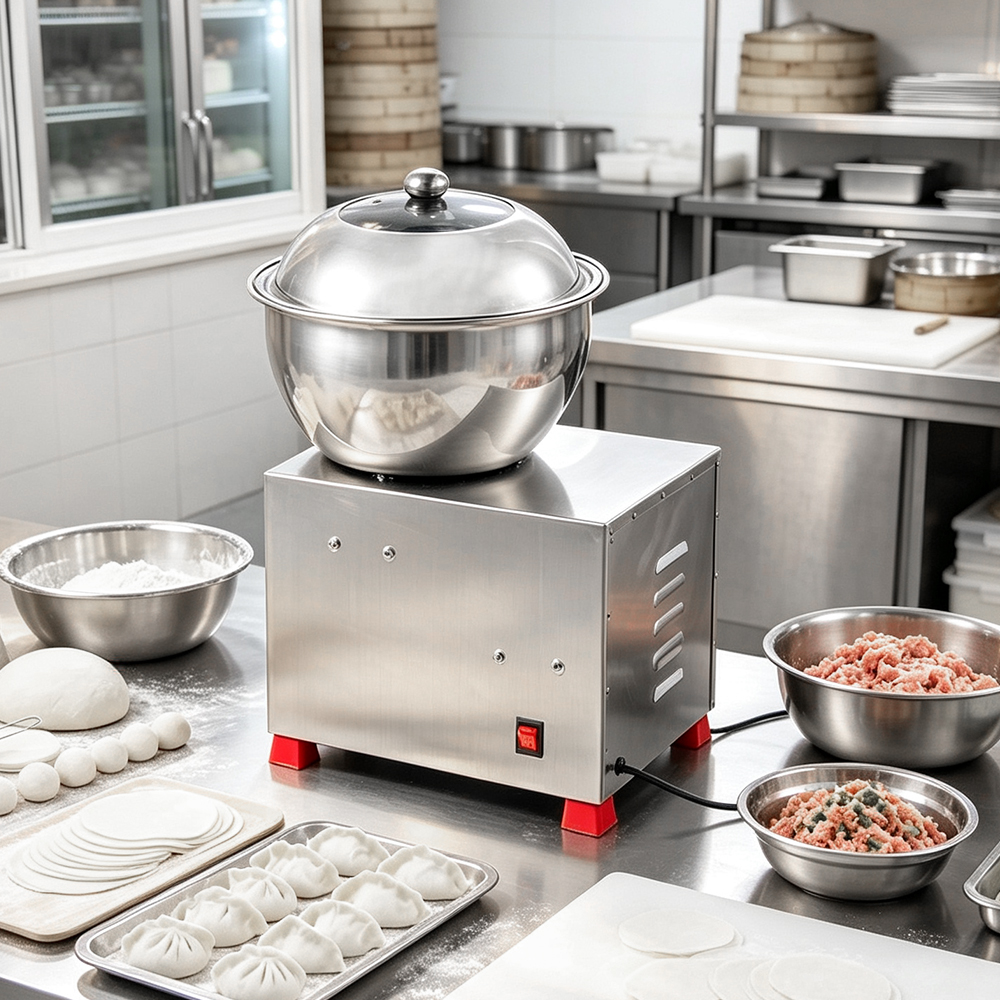
 Model 450 Large Granular Vegetable Mincer for Commercial ChoppingHigh-capacity stainless four-blade vegetable chopper producing 250–400 kg per hour, suited to continuous fillings for canteens and frozen production.View Product →
Material hardness, fat content and product temperature decide the machine class more than daily volume does: frozen blocks and dense root vegetables need the 3000 W class, fresh boneless trim runs efficiently on a heavy duty commercial mincer, and leafy vegetables or cooked fillings run comfortably on 550 W to 750 W high-speed units.
| Material | Recommended class | What the wrong machine does |
| Frozen meat blocks | 3000 W class, four-blade cutter | Stalls, overheats the winding, smears fat instead of cutting |
| Fresh boneless pork or beef trim | Heavy duty commercial mincer, all-steel feed | Slows under continuous loading and raises product temperature |
| Root vegetables such as carrot and potato | 750 W to 1000 W granulator | Chatters, produces uneven granules, dulls the plate fast |
| Leafy vegetables and cooked fillings | 550 W to 750 W high-speed unit | Over-processes the product into paste |
| Garlic, ginger and chili paste | 1000 W and above, 304 stainless contacts | Acid and oil attack plated and lower-grade steel |
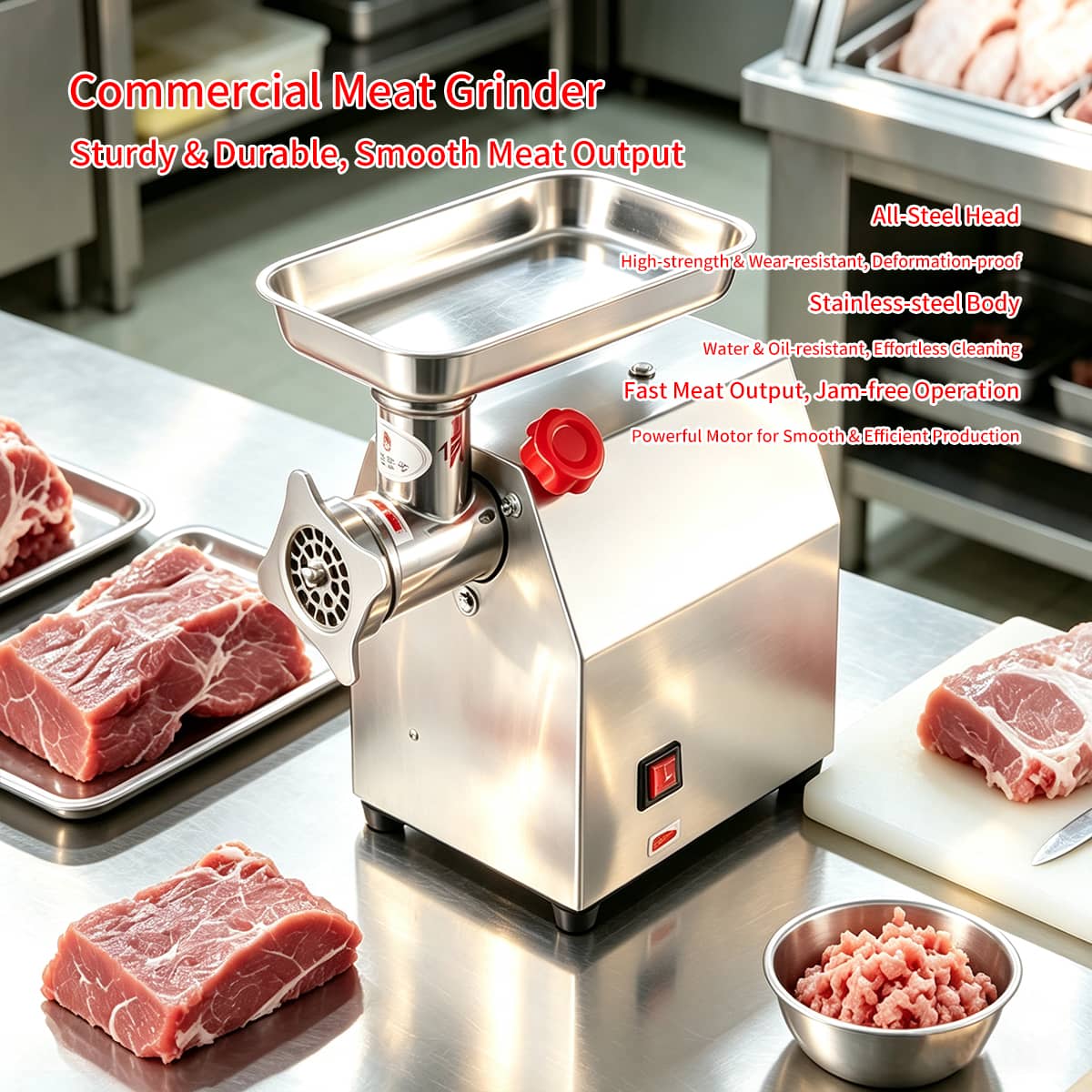
 Heavy-Duty Model 12/2/32 Commercial Electric Meat GrinderHeavy-duty commercial meat grinder in the meat grinder category; published details are limited to its name, model number, and intended commercial class.View Product →
Every surface that touches food should be AISI 304 stainless steel, designated EN 1.4301 and containing roughly 18 percent chromium and 8 percent nickel; 304 resists the organic acids in meat, onion, garlic and chili paste that pit painted carbon steel and lower-grade 201 stainless within months of daily service.
All-steel against semi-steel is a construction decision, not a marketing one. If the machine stands within two metres of a wash-down hose, the housing matters as much as the auger, because water reaches the motor through a seam long before it reaches the bearing.
Heavy-Duty Model 22 All-Steel Commercial Meat MincerTable-top 1500 W meat mincer with 100–250 kg/h output, stainless contact parts, and detachable grinding head for butcher shops, canteens, and dumpling fillings.View Product →
Most heavy duty grinder failures trace back to installation and cleaning practice rather than manufacturing defects: undersized circuits, water entering the motor housing, and blades run past their working edge account for the majority of premature repairs.
Check whether the unit is 220 V single phase or 380 V three phase, and confirm the circuit rating against full-load current. A 3000 W machine at 220 V needs a dedicated 20 A circuit with residual current protection.
Motor cooling depends on airflow. A grinder pushed against a wall runs hotter than its design temperature, and every ten degrees of extra winding temperature roughly halves insulation life.
Raw ground meat must be held at 4 degrees Celsius or below under USDA FSIS cold-chain guidance. Chilling trim before it enters the feed reduces friction heat and keeps the finished product inside the limit.
A worn plate with a fresh blade smears rather than cuts. Replace or resharpen both together, and inspect the pair weekly on machines processing more than 100 kg per day.
Strip removable parts and wash them separately. Hosing down an assembled machine drives water past the shaft seal and into the bearing housing, which is the most expensive shortcut in the kitchen.
The dominant failure modes in commercial grinders are winding burnout from stalled feed, bearing and seal failure from wet cleaning, and cutting-plate wear; all three accelerate when a machine runs at 100 percent of its rated duty for hours at a time.
Product temperature is the cost that never appears on a quotation. Every minute of friction inside the cutting chamber pushes product temperature toward the 4 degree Celsius holding limit, and a batch that crosses it is a total loss rather than a discounted one.
Work through this list before releasing a purchase order; each item maps to a failure mode that appears within the first year when it is skipped.
750 W is the practical floor for a restaurant grinding fresh meat daily, and 1000 W to 3000 W is required for frozen product, granulated vegetable stuffing or runs lasting more than two hours. The 450 large granular vegetable mincer, for reference, is rated at 3000 W with a four-blade cutting set.
Yes. AISI 304, designated EN 1.4301, contains about 18 percent chromium and 8 percent nickel, which is what resists the organic acids and salts in meat, onion and chili paste. Grade 201 and coated carbon steel discolour and pit in the same service within a few months.
Yes. A 3000 W machine on 220 V draws about 13.6 A at full load, so a dedicated 20 A circuit with residual current protection is the minimum. Sharing a circuit with a fryer or water heater produces voltage drop that reappears as overheating.
Inspect the cutting set weekly and replace blade and plate as a matched pair. On a machine processing around 100 kg a day, expect to resharpen or replace the set every three to six months. A blade that no longer shaves paper raises product temperature and produces smeared rather than cut texture.
Nothing on a specification sheet compensates for a machine run at its limit from open to close. Size the motor for the heaviest product in a normal week, keep the cutting set matched and sharp, and the grinder stops being a maintenance item and starts being a piece of equipment.
Need more information about Ruilong solutions? Need to contact Ruilong sales or after sales assistance? Get in touch!
+86 15868095986
659871326@qq.com
Rm 2, 5/F, East of Block A, 127 Jinniu Rd, Xiangzhu 1 Village (Natural Village), Xiangzhu Town, Yongkang, Jinhua, Zhejiang, China

 | Login